 By
By 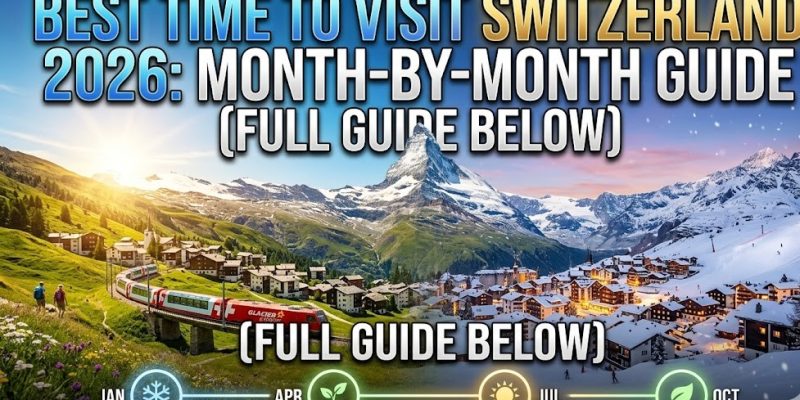
It is March 28, 2026, and if you are currently standing in Interlaken, you are witnessing a literal “Identity Crisis.” Down in the valley, the first crocuses are pushing through the damp soil, but look up toward the Eiger, and you’ll see a landscape still locked in a deep, crystalline freeze.
In Switzerland, “Spring” isn’t a date on a calendar; it’s an altitude. For the savvy traveler planning the remainder of 2026, the challenge is mastering the “Three Cs”: Costs, Clouds, and Crowds. Whether you are chasing the thundering melt of the Staubbach Falls or the clear, sapphire skies of a September trek, timing is your most valuable currency.
The Vertical Climate Equation
The most critical mistake travelers make in the Alps is assuming the weather at 500m (Interlaken) matches the weather at 3,454m (Jungfraujoch). Meteorologically, the Alps follow a standard environmental lapse rate. For every $100\text{m}$ of elevation gain, the temperature typically drops by approximately $0.65^\circ\text{C}$.
The temperature at your destination altitude ($T_h$) can be estimated as:
(Where $T_0$ is the valley temperature and $\Delta h$ is the elevation gain in meters).
This is why, on this very day in late March, it might be a crisp $9^\circ\text{C}$ in the streets of Interlaken but a brutal $-15^\circ\text{C}$ at the Top of Europe. Always consult the MeteoSwiss Official Forecast before heading to the station.
The 2026 Travel Year: A Data-Driven Breakdown
Using Interlaken as our primary hub, here is how the rest of 2026 shakes out for your budget and your Vitamin D levels.
| Month | Avg. High | Sunny Days | Precipitation | Airbnb Cost Rank |
| January | $36^\circ\text{F}$ | 7 | 9 Days | 4th Cheapest |
| February | $40^\circ\text{F}$ | 5 | 3 Days | Least Expensive |
| March | $48^\circ\text{F}$ | 10 | 11 Days | 5th Cheapest |
| April | $54^\circ\text{F}$ | 14 | 12 Days | 7th Cheapest |
| May | $64^\circ\text{F}$ | 11 | 19 Days | 9th Cheapest |
| June | $70^\circ\text{F}$ | 12 | 18 Days | 2nd Most Expensive |
| July | $75^\circ\text{F}$ | 14 | 17 Days | Most Expensive |
| August | $75^\circ\text{F}$ | 16 | 15 Days | 3rd Most Expensive |
| September | $68^\circ\text{F}$ | 20 | 10 Days | 5th Most Expensive |
| October | $57^\circ\text{F}$ | 22 | 8 Days | 6th Cheapest |
| November | $45^\circ\text{F}$ | 15 | 8 Days | 3rd Cheapest |
| December | $38^\circ\text{F}$ | 11 | 8 Days | 2nd Cheapest |
Strategic Windows: Finding Your Ideal “Vibe”
The “Budget & Bloom” Seekers (April – June)
As the snow melts, the waterfalls in the Lauterbrunnen Valley reach their peak thundering glory. This is the best time for photography, but be warned: May is statistically the rainiest month. The Harder Kulm Funicular typically opens in mid-April, offering the first clear sunset views of the season over Lake Thun and Lake Brienz.
The High-Alpine Hikers (July – September)
This is when the world-class trails above $2,000\text{m}$ finally become accessible. If you want the “Goldilocks” experience—stable weather and fewer crowds—aim for the first half of September. By then, the summer vacationers have returned home, but the mountain lifts are still in full summer operation.
The Authentic Autumn Enthusiast (October)
October is the locals’ best-kept secret. It is the sunniest month of the entire year, and the foliage turns the valley into a sea of gold and copper. However, check the Jungfrau Region Maintenance Schedule closely, as many cable cars (like the one to Mürren or Grindelwald-First) begin their seasonal “nap” at the end of the month.
Crucial 2026 Planning Warnings
-
The Maintenance Gap: Do not assume every train runs 365 days a year. While the Jungfraujoch and the Eiger Express are major hubs, secondary lifts often close for 2–3 weeks in May and November.
-
Rail Pass Strategy: In 2026, the Swiss Travel Pass remains the gold standard for flexibility, but if you are staying purely in the Interlaken/Jungfrau area, the Berner Oberland Pass offers significantly better value for mountain excursions.

Conclusion
Switzerland in 2026 is a masterpiece of logistics and natural beauty, but it rewards those who do their homework. Whether you are braving the blizzards of the Jungfraujoch in May or soaking in the clear October sun, the secret is in the layers—both in your clothing and your planning. Follow the data, respect the vertical lapse rate, and remember: there is no such thing as bad weather in the Alps, only bad equipment.
Also Read : Best Honeymoon Destinations in the World in 2026: Romantic Escapes for Every Budget