 By
By 
Spain’s vast history is not merely preserved inside textbooks; it is physically etched into the stone and tile of its monumental city skylines. For any curious traveler, the sheer diversity of landmarks across the Iberian Peninsula offers a breathtaking look into the successive waves of Roman engineering, Moorish mathematical architecture, and grand Christian design that have shaped the region over two millennia.
When experienced through the lens of priority-access curators like Insight Vacations, these structural monuments transform from mere tourist photo-ops into deep historical narratives. This comprehensive technical brief evaluates 12 essential historical landmarks in Spain, deconstructing their architectural mechanics, hydraulic innovations, and cultural evolution.
Technical Mechanics: The Interlocking Styles of the Iberian Peninsula
To fully appreciate Spain’s built environment, architects track three foundational engineering traditions:
-
Gravity-Locked Roman Dry-Stacking: Roman civic structures like the Aqueduct of Segovia rely entirely on the absolute precision of stone-cutting and gravity weight. Lacking any mortar or cement, the friction points between blocks distribute load forces perfectly down into foundational pillars.
-
Moorish Acoustic Hydraulics: Islamic architecture—seen vividly across the Alhambra and the Alcázar of Seville—views water as an active structural element. Sophisticated gravity-fed channels, low-velocity reflecting pools, and trickling fountains were engineered to modify local microclimates, enhance visual symmetry, and mask private court conversations from outside eavesdroppers.
-
Mudéjar Structural Syncretism: Following the Christian Reconquista, conquering monarchs routinely commissioned highly skilled Islamic craftsmen to build their royal palaces and cathedrals. This birthed the unique Mudéjar style, which overlays delicate Islamic geometric brickwork, calligraphic plaster carvings, and complex timber ceilings directly onto heavy Christian Gothic frameworks.
1. La Sagrada Família, Barcelona
-
Architectural Signature: Catalan Modernism / Biomimetic Gothic
-
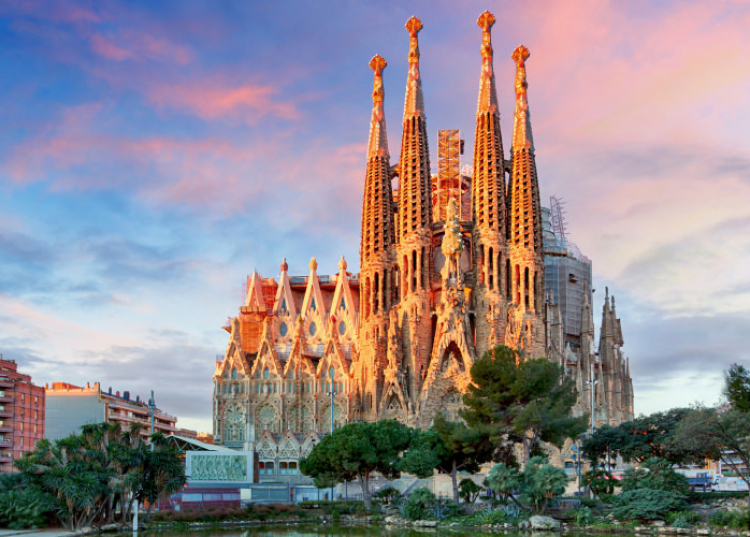
Engineering Core: Antoni Gaudí’s legendary basilica stands as a triumph of structural organic engineering. Rather than relying on traditional, heavy flying buttresses to handle roof loads, Gaudí designed the massive interior pillars to mimic a dense forest. The columns branch out at their crowns to support the stone ceiling, utilizing ascending helices to draw the eye upward while maximizing vertical load distribution. The stained-glass arrays are strategically oriented: the eastern walls filter the cool blues and greens of the morning sun, while the western windows project the fiery reds and oranges of late afternoon.
-
2026 Milestone: Construction initialized in 1882. As the project reaches its historic 2026 target milestone—marking the centennial of Gaudí’s passing—the primary architectural shell, including the towering central Spire of Jesus Christ, is nearing formal structural completion, though finer decorative details on the Glory Facade will continue to evolve.
2. The Alhambra, Granada
-
Architectural Signature: Nasrid Islamic / Charles V Renaissance
-
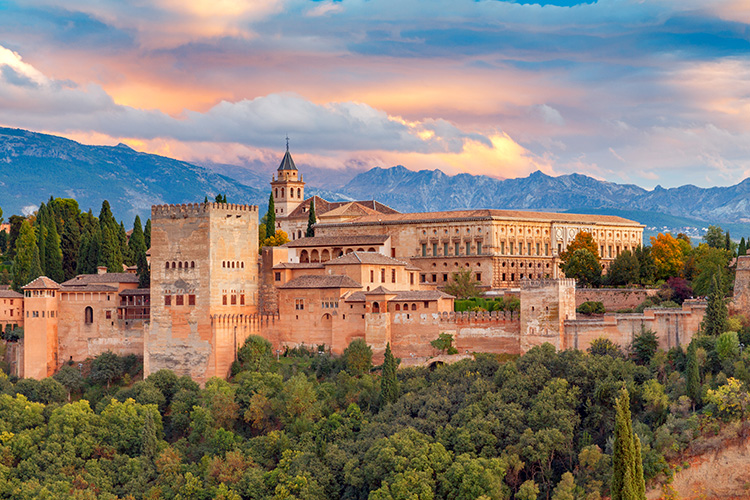
Engineering Core: Crowning a steep strategic plateau, this sprawling fortress-palace served as the final Moorish stronghold in Spain until 1492. The complex functions as a masterclass in advanced fluid dynamics, redirecting mountain river streams into a sophisticated network of palace channels and fountains across the Generalife gardens. Following the Reconquista, King Charles V constructed a massive, sharply circular Renaissance palace directly within the Islamic walls, creating a striking contrast between delicate, mathematical Islamic art and the heavy stone blocks of the Spanish Empire.
3. Santiago de Compostela Cathedral, Galicia
-
Architectural Signature: Romanesque Core / Baroque Facade
-
Engineering Core: For over a millennium, this grand cathedral has served as the ultimate finish line for pilgrims completing the Camino de Santiago. Beneath its highly detailed Baroque exterior lies the original 12th-century Romanesque Pórtico de la Gloria, recognized as one of the finest medieval sculptures in existence. A unique mechanical feature is the Botafumeiro, a massive, 1.5-meter-tall incense burner. Suspended from a complex pulley system, it is swung through the transept at speeds reaching 40 mph (64 km/h)—a ritual originally engineered to mask the scent of thousands of unwashed pilgrims sleeping on the church floor.
4. Aqueduct of Segovia
-
Architectural Signature: Imperial Roman Infrastructure
-
Engineering Core: Constructed during the 1st century AD to transport fresh mountain water from the Frío River to the city, this engineering marvel stands completely independent of mortar, lime, or cement. Over 20,000 massive granite blocks are stacked perfectly in a double-tiered arch network, relying entirely on raw gravity compression and precision stone friction to stay standing. Close observation of the granite faces exposes small pockmark holes where ancient Roman scissor-clamps gripped the stones during crane hoist maneuvers.
5. Toledo Old Town
-
Architectural Signature: Multi-Cultural Urban Fusion
-
Engineering Core: Situated on a rocky hill surrounded on three sides by the Tagus River, Toledo served as the capital of the Spanish Empire until the 16th century. Known historically as the “City of the Three Cultures,” it stands as a rare example where Christian, Jewish, and Moorish communities lived in close proximity. This co-existence fostered the famous School of Translators, preserving classical Greek and Arabic knowledge for Renaissance Europe. The layout features narrow, maze-like streets containing 12th-century synagogues styled with Islamic motifs and a massive Gothic cathedral.
6. Alcázar of Seville
-
Architectural Signature: High Mudéjar Palace Architecture
-
Engineering Core: Holding the distinction of being the oldest royal palace still in active use in Europe, the Alcázar is the ultimate expression of the Mudéjar style. Christian kings hired talented Moorish artisans to construct their personal residences, yielding an intricate labyrinth of geometric tile patterns and complex stuccowork. Deep beneath the palace gardens sit the Baths of Lady María de Padilla, a series of vaulted rainwater cisterns that maintain a remarkably cool temperature during the intense Andalusian summer heat.
7. Seville Cathedral
-
Architectural Signature: High Gothic / Almohad Mosque Foundations
-
Engineering Core: Built directly over the foundations of the city’s former Great Mosque, this structure ranks as the largest Gothic cathedral on Earth. Its builders initialized construction with the explicit decree to build a monument “so grand that those who see it finished will think we are mad.” The interior houses the official tomb of Christopher Columbus, validated by modern DNA tracking. The iconic Giralda bell tower—originally the mosque’s minaret—utilizes a series of 34 interior ramps instead of stairs, allowing the Sultan to ride his horse directly to the top summit.
8. Roman Theatre of Mérida
-
Architectural Signature: Classical Roman Theatre Design
-
Engineering Core: Erected between 16 and 15 BC in the ancient capital of Lusitania, this performance arena remains so structurally sound that it still hosts a major international classical drama festival every summer. Designed to accommodate 6,000 spectators, its most striking element is the Scaenae Frons—a magnificent stage background featuring two tiers of Corinthian columns and marble statues of deities like Ceres and Pluto. The theatre survived the centuries because it was buried completely underground for eras, shielding the fine stone from being scavenged for local building projects.
9. Montserrat Monastery
-
Architectural Signature: Mountain Benedictine Monastic Complex
-
Engineering Core: Perched high within the unique, serrated mountains of Catalonia, this historic Benedictine abbey houses the Virgen de Montserrat (The Black Madonna), a revered 9th-century carving. Beyond its spiritual value, the site is a major geological wonder. The distinct, smooth pink conglomerate rock spires were formed millions of years ago when the region sat entirely underwater, creating a jagged, wind-carved mountain barrier that isolates the monastery from the lowlands below.
10. El Escorial
-
Architectural Signature: Herrerian Renaissance Granite Grid
-
Engineering Core: Commissioned by King Philip II near Madrid, this massive granite complex functions as a royal palace, monastery, and mausoleum simultaneously. Built in a strict gridiron layout to honor St. Lawrence, its architecture is defined by sharp, un-ornamented geometry known as the Herrerian style. Its most striking internal feature is the Pantheon of the Kings, an octagonal marble and jasper chamber positioned directly beneath the high altar that houses the gilded tombs of nearly every Spanish monarch from the past five centuries.
11. Córdoba Roman Bridge
-
Architectural Signature: Roman Arched Bridge Network
-
Engineering Core: Spanning the wide Guadalquivir River, the 16 stone arches of this bridge have connected Córdoba’s southern approaches for two millennia. While much of the upper stone casing was restored during Moorish and medieval expansions, the lower underwater foundations consist of original Roman masonry blocks. During the medieval era, the bridge functioned as a vital military choke point, anchored on the southern bank by the fortified Calahorra Tower to control flow into the city.
12. Tower of Hercules
-
Architectural Signature: Functional Roman Lighthouse
-
Engineering Core: Situated on the rugged, wave-battered coast of A Coruña in Galicia, this is the only Roman lighthouse in the world that still functions as an active maritime signal. While the exterior was wrapped in a neoclassical protective stone “jacket” during the 1700s to counter erosion, visitors can step inside the structure to explore the original, core 2nd-century Roman masonry walls. The Romans selected this cliffside spot because they believed it represented the Finis Terrae—the absolute end of the known world.
Historical Era and Geographic Orientation Matrix
This master structural matrix organizes Spain’s 12 essential landmarks by their primary building era, regional autonomous community, and core engineering focus to help you plan your upcoming journey.
| Landmark Name | Regional Territory | Primary Building Era | Core Engineering Focus | Primary Material Base |
| La Sagrada Família | Catalonia (Barcelona) | Modernist (1882–2026) | Biomimetic Pillar Columns | Reinforced Concrete & Stone |
| The Alhambra | Andalusia (Granada) | Nasrid Islamic (13th c.) | Acoustic Fluid Hydraulics | Red Tapia Adobe & Marble |
| Santiago Cathedral | Galicia (Compostela) | Romanesque Core / Baroque | High-Velocity Pulley Systems | Local Galician Granite |
| Aqueduct of Segovia | Castile and León | Roman Imperial (1st c. AD) | Mortarless Gravity Locking | Dry-Stacked Granite Blocks |
| Toledo Old Town | Castile-La Mancha | Medieval Mudéjar / Gothic | Multi-Cultural Co-existence | Brick, Stone, and Plaster |
| Alcázar of Seville | Andalusia (Seville) | High Mudéjar (14th c.) | Vaulted Underground Cisterns | Plaster Stucco & Ceramic Tile |
| Seville Cathedral | Andalusia (Seville) | Late High Gothic (15th c.) | Interior Equestrian Ramps | Carved Limestone & Alabaster |
| Theatre of Mérida | Extremadura (Mérida) | Roman Imperial (15 BC) | Two-Tier Corinthian Stage | Italian Marble & Granite |
| Montserrat Monastery | Catalonia (Montserrat) | Monastic Gothic / Modern | Mountain Conglomerate Isolation | Pink Mountain Conglomerate |
| El Escorial | Community of Madrid | Herrerian Renaissance | Royal Vaulted Mausoleums | High-Density Grey Granite |
| Córdoba Roman Bridge | Andalusia (Córdoba) | Roman Foundations / Moorish | Submerged River Pier Foundations | Raw Masonry & Cut Ashlar |
| Tower of Hercules | Galicia (A Coruña) | Roman Core (2nd c. AD) | Continuous Maritime Signaling | Roman Masonry & Neoclassical Wrap |
Essential Travel Architecture and Preservation Guidelines
To ensure a safe, organized, and culturally rich journey across Spain’s delicate historic landmarks, keep these foundational rules in mind:
-
Secure Advanced Priority Ticketing: High-demand monuments like the Alhambra, the Alcázar of Seville, and La Sagrada Família enforce strict daily visitor caps to protect their delicate internal microclimates from human moisture erosion. Booking priority-access passes weeks in advance or traveling via organized premium itineraries like Insight Vacations is absolutely mandatory to bypass massive exterior standby lines.
-
Wear High-Traction Footwear for Stone Trait Paths: The ancient stone walkways tracking through Toledo, the Córdoba Bridge, and Mérida are exceptionally slick due to two thousand years of continuous foot polishing. Standard flat-soled sneakers or leather shoes fail to grip these surfaces well, especially after brief rain showers. Always pack broken-in, high-traction walking shoes or lightweight trail boots to ensure steady footing.
-
Respect High-Humidity Photography Bans: Sensitive interior spaces—such as the Pantheon of the Kings in El Escorial or the Pórtico de la Gloria in Santiago de Compostela—frequently enforce absolute bans on flash photography. High-intensity strobe flashes release trace thermal energy that can degrade ancient paint pigments and delicate marble finishes over time. Always double-check local signage and keep your camera flashes disabled to preserve these structural treasures for future generations.
Conclusion
The definitive architectural verdict on Spain’s legendary landmarks confirms that the built heritage of the Iberian Peninsula represents an unparalleled fusion of human creativity and technical engineering. Whether you are analyzing the mortarless precision of Segovia’s Roman arches or exploring the light-filtering columns of La Sagrada Família in Barcelona, these structures stand as magnificent physical archives of the empires that raised them. By coordinating your exploration routes with specific historical timelines and utilizing the priority-access curation found across premier travel programs, you can safely step up to the edge of these great stone wonders to experience the enduring majesty of Spain’s living past.