 By
By 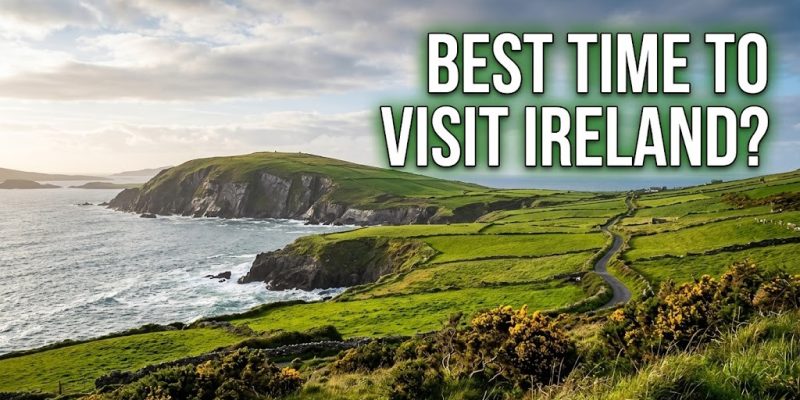
Let’s be honest: planning a trip to Ireland based strictly on the weather is like trying to catch a leprechaun—optimistic, but statistically unlikely to go as planned. In Ireland, “four seasons in one day” isn’t a cliché; it’s the local forecast. However, the unpredictable Atlantic winds are exactly what gift the country its “Emerald Isle” moniker.
Whether you’re looking for the high-octane energy of a Dublin festival or the haunting silence of a UNESCO World Heritage site like Skellig Michael, timing your 2026 trip is about matching your personal “vibe” to the Irish calendar.

The Science: The “Daylight Availability” Formula
In Ireland, the most significant variable isn’t just temperature; it’s daylight. Between the winter solstice and the summer peak, your “adventure window” ($A_w$) shifts dramatically. We can model the planning efficiency as:
In June, your $A_w$ extends until 10:30 PM, whereas in December, the “curtain” closes by 4:00 PM. This formula is why summer remains the undisputed king for road trippers.
Seasonal Snapshot: 2026 Comparison
| Season | Months | Avg Temp | Travel Tier | Best For… |
| Spring | Mar – May | 8°C – 12°C | Shoulder | St. Patrick’s Day & Wildflowers |
| Summer | Jun – Aug | 16°C – 22°C | Peak | Festivals & The Wild Atlantic Way |
| Autumn | Sep – Oct | 14°C – 18°C | Shoulder | Hiking & Halloween Roots |
| Winter | Nov – Feb | 4°C – 10°C | Off-Peak | Cozy Pubs & Castle Stays |
The Deep Dive: Choosing Your Month
1. Spring: The Green Resurrection
March brings the iconic St. Patrick’s Festival, which has evolved into a week-long celebration of music and culture. While it’s breezy and chilly, it’s also the season with the least amount of rain.
-
Why now? You get to see the landscape transform from winter-dull to neon-green.
-
The “Candor” Note: It’s still cold. Don’t let the “Spring” label fool you; bring your woolens.
2. Summer: The Emerald Peak
June to August offers the best “rainbow weather.” It rains frequently, but the immediate sunshine that follows creates the most stunning vistas at the Cliffs of Moher.
-
The Draw: 18+ hours of daylight. You can have dinner at 8:00 PM and still go for a cliffside walk in broad daylight.
-
The Catch: Prices are at their highest. Book your 2026 summer flights 6 months in advance.
3. Autumn: The Celtic Twilight
September is arguably the best month to visit. The crowds thin out, the weather remains relatively mild, and the foliage turns a deep burnt orange.
-
The Highlight: Ireland is the birthplace of Halloween (Samhain). Visiting in late October offers a mystical experience you won’t find anywhere else.
4. Winter: The Castle Reset
If you don’t mind the “great damp,” winter is the time for luxury. You can stay in 5-star historic Irish castles for a fraction of the summer price.
-
The Vibe: Turf fires, Irish coffee, and traditional folk sessions in half-empty pubs.
The “Snake-Island” Survival Rule:
There are no snakes in Ireland (thanks, St. Patrick), but there is plenty of rain. Carry a high-quality waterproof shell. In Ireland, umbrellas are often sacrificial offerings to the Atlantic wind—a hooded raincoat is your true best friend.

Conclusion
There is no “bad” time to visit Ireland in 2026; there is only “inappropriate clothing.” If you want the full cultural experience with maximum daylight, aim for June or July. If you’re looking for a soulful, budget-friendly retreat where you can claim a castle as your own, January and February are your hidden gems. Regardless of when you go, the mix of Neolithic history, lush meadows, and legendary hospitality remains constant. Ireland doesn’t just show you its beauty; it makes you feel it, usually accompanied by a perfectly poured pint of Guinness
Also Read : Going it Alone: 10 Best Places to Visit for Solo Travelers (2026 Edition)