 By
By 
Across the European continent, the architectural legacy of the Middle Ages, the Renaissance, and 19th-century Romanticism lives on in an extraordinary concentration of defensive fortresses and royal residences. Perched atop dizzying Alpine crags, built directly into towering limestone cliff faces, or suspended over misty Scottish lochs, these structures bridge the boundary between historical military engineering and pure visual fantasy. Behind their stone battlements, soaring spires, and drawbridges lie centuries of dynastic ambitions, strategic resource control, and structural evolution.
This architectural and geographic guide breaks down 10 of Europe’s most breathtaking, fairy-tale castles, analyzing their structural design nodes, defensive layouts, and environmental integration.

1. Neuschwanstein Castle, Germany
-
Location: Schwangau, Bavarian Alps, Germany
-
Architectural Typography: Romanesque Revival / Late 19th-Century Historicism
-
Structural Mechanics: Commissioned by King Ludwig II of Bavaria in 1869, Neuschwanstein is a theatrical monument to medieval German lore rather than a functional military asset. Perched precariously above the Pöllat Gorge, its crisp limestone-faced towers and slate-blue roofs utilize advanced late-19th-century engineering—including internal steel structural beams, a complex hot-air heating matrix, and encapsulated running water systems. Its iconic, asymmetrical silhouette directly inspired the template for standard global theme-park architecture.
-
Design Highlight: The soaring Singer’s Hall and the Throne Room, which feature intricate Byzantine-inspired mosaics and gold-leaf vaulted ceilings.
2. Bran Castle, Romania
-
Location: Bran, Transylvania, Romania
-
Architectural Typography: Gothic / Medieval Defensive Fortress
-
Structural Mechanics: Completed in 1388 atop a jagged, 60-meter-high volcanic rock promontory, Bran Castle was engineered as a customs checkpoint and military bastion to monitor the Rucăr-Bran alpine pass against Ottoman incursions. The structure features thick, asymmetrical limestone walls, narrow modular shooting loops, and inward-facing inner courtyards. Crowned with steep, red-tiled timber roofs, its imposing profile remains inextricably linked with Bram Stoker’s Dracula and Transylvanian folklore.
-
Design Highlight: The secret subterranean defensive escape tunnels winding through the bedrock beneath the central keep.
3. Château de Chambord, France
-
Location: Loire Valley, Loir-et-Cher, France
-
Architectural Typography: French Renaissance / Italianate Fusion
-
Structural Mechanics: Commissioned by King Francis I in 1519 as a grand royal hunting lodge, Chambord represents a profound departure from dark medieval fortresses into open, symmetrical Renaissance symmetry. Encircled by a vast forested game park, its massive facade blends a traditional French medieval layout (four massive round towers) with ornate Italian classical order details. Its ornate, busy skyline is populated by hundreds of highly detailed chimneys, dormer windows, and carved cupolas that cut a striking pattern against the horizon.
-
Design Highlight: The legendary central open-core double-helix staircase, historically attributed to the structural circles of Leonardo da Vinci.
4. Predjama Castle, Slovenia
-
Location: Postojna Cave System, Inner Carniola, Slovenia
-
Architectural Typography: Gothic Renaissance / Cave-Integrated Bastion
-
Structural Mechanics: Few fortresses on Earth match the absolute tactical security of Predjama, which is built directly inside the gaping mouth of a 123-meter-high vertical limestone cliff face. First constructed in the 12th century and reinforced in the 15th century, the castle’s rear stone walls melt directly into a vast natural cave matrix. This underground network provided the rebellious knight Erasmus of Lug with secret supply lines and fresh water tunnels during long military sieges.
-
Design Highlight: The raw, un-carved natural rock faces that form the interior support structures of the main dining and living quarters.
5. Eilean Donan Castle, Scotland
-
Location: Dornie, Western Highlands, Scotland
-
Architectural Typography: Scottish Baronial / Medieval Keep Reconstruction
-
Structural Mechanics: Sited on a tiny, isolated tidal island where three sea lochs (Loch Duich, Loch Long, and Loch Alsh) converge, Eilean Donan was originally built in the 13th century to protect Kintail from Norse raiders. Blown apart by royal naval cannons during the Jacobite rising in 1719, the castle lay in ruins for nearly two centuries until Lt. Col. John MacRae-Gilstrap meticulously reconstructed the keep between 1912 and 1932. It connects to the mainland via an iconic, multi-arched stone bridge.
-
Design Highlight: The massive, three-meter-thick defensive walls and the solid oak banqueting hall roof timbers.
6. The Alcázar of Segovia, Spain
-
Location: Segovia, Castile and León, Spain
-
Architectural Typography: Mudéjar Gothic / Herrerian Renaissance Fusion
-
Structural Mechanics: Rising dramatically from a rocky crag at the confluence of the Eresma and Clamores rivers, the Alcázar’s unique, sharp-edged floor plan directly mimics the pointed prow of a massive stone ship slicing through the Castilian plains. Originally a Roman and Moorish wooden fort, it evolved over centuries into a premier royal residence for the Kings of Castile, featuring tall cylindrical turrets, deep defensive dry moats, and conical slate roofs added by King Philip II.
-
Design Highlight: The Tower of John II, a massive, 80-meter-high rectangular keep crowned with twelve ornate defensive turrets.
7. Hohenzollern Castle, Germany
-
Location: Mount Hohenzollern, Swabian Jura, Germany
-
Architectural Typography: Neo-Gothic Revival
-
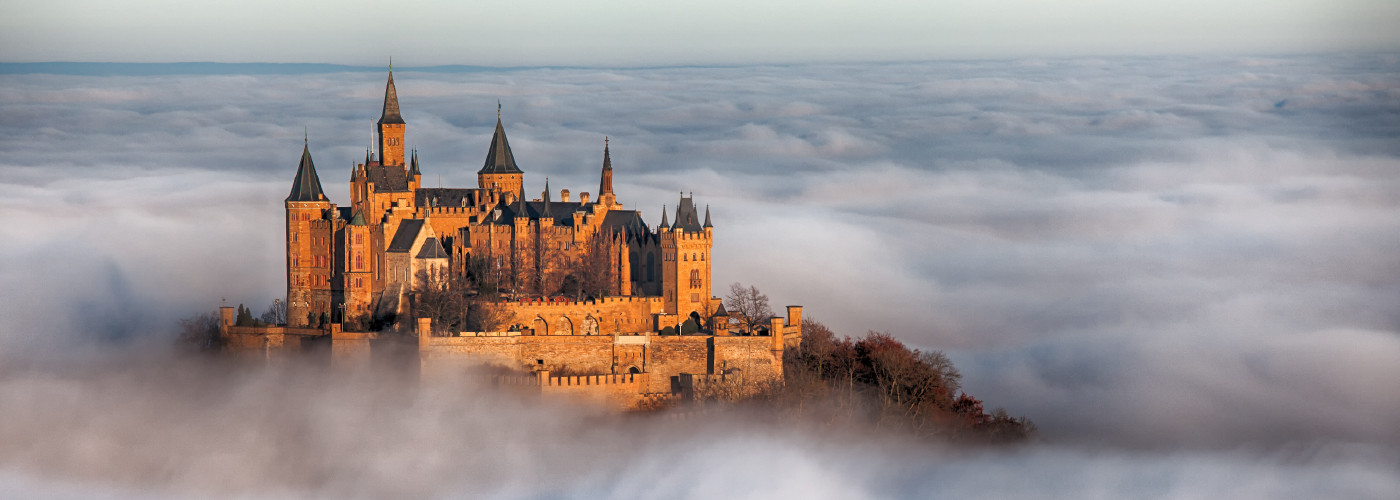
Structural Mechanics: Crowned majestically atop an isolated mountain peak nearly 900 meters above sea level, this castle serves as the ancestral seat of the imperial House of Hohenzollern. The current structure, completed in 1867 by King Frederick William IV of Prussia, is an architectural masterpiece of romantic Neo-Gothic design. It features monumental crenellated ramparts, sprawling defensive bastions, and multiple soaring spires that slice dramatically through the low-hanging cloud decks.
-
Design Highlight: The Count’s Hall, a grand, double-naved Gothic banqueting room supported by polished red marble columns.
8. Corvin Castle, Romania
-
Location: Hunedoara, Transylvania, Romania
-
Architectural Typography: Gothic-Renaissance / High-Density Medieval Fortress
-
Structural Mechanics: Connected to the surrounding cliffs by a single, dizzyingly high wooden drawbridge resting on massive stone piers, Corvin Castle (also known as Hunyad Castle) is one of Eastern Europe’s largest fortresses. Built in the 15th century by the powerful Hunyadi family, it exhibits classic, high-stakes medieval military design, complete with circular defense towers, deep interior courtyards, colorful private loggias, and sharp, imposing gargoyles carved into the stone facades.
-
Design Highlight: The towering Knights’ Hall, an expansive ceremonial space lined with marble pillars and heraldic flags.
9. Golubac Fortress, Serbia
-
Location: Golubac, Djerdap National Park, Serbia
-
Architectural Typography: Medieval Military Defensive Complex
-
Structural Mechanics: Clinging to the sheer cliffs at the entrance of the dramatic Iron Gates Gorge—where the Danube River narrows sharply—Golubac Fortress features ten heavy-set, interconnected defensive towers. Built in the 14th century, the fortress was partitioned into three distinct defensive compounds (Upper, Middle, and Lower towns) to control and levy heavy taxes on all maritime transport moving through the Balkans. It has undergone a major, state-backed structural restoration in recent years.
-
Design Highlight: The ancient Hat Tower, a massive octagonal citadel built directly onto the highest point of the rock face.
10. Bled Castle, Slovenia
-
Location: Lake Bled, Julian Alps, Slovenia
-
Architectural Typography: Romanesque / Renaissance Mix
-
Structural Mechanics: Towering vertically exactly 130 meters above the turquoise glacial waters of Lake Bled, this fortress stands as Slovenia’s oldest recorded castle, first mentioned in official imperial documents in 1011 AD. The complex is divided into two distinct levels: a lower courtyard holding domestic administrative quarters, and a heavily fortified upper courtyard housing the lord’s residence and a Gothic chapel, providing spectacular panoramic lookouts over the Julian Alps.
-
Design Highlight: The fully operational 16th-century printing shop, which utilizes a reconstructed wooden Gutenberg press to replicate historical print techniques.
Castle Architectural and Geographic Matrix
This master matrix organizes Europe’s top 10 fairy-tale castles by their country, primary design era, and core environmental foundation to help travelers map out their architectural study routes.
| Historical Property | Country Location | Core Architectural Node | Environmental Foundation Node | Signature Structural Moat |
| Neuschwanstein | Germany | Romanesque Revival | High-Altitude Alpine Crag | Asymmetrical white limestone towers and steel-reinforced framing. |
| Bran | Romania | Gothic / Medieval | Volulosic Volcanic Rock | High-density defensive walls overseeing an alpine transit gorge. |
| Chambord | France | French Renaissance | Forested Lowland Wetlands | A massive classical facade featuring a central double-helix staircase. |
| Predjama | Slovenia | Gothic / Renaissance | Cave-Mouth Limestone Cliff | Rear walls built directly inside a 123-meter vertical cavern system. |
| Eilean Donan | Scotland | Scottish Baronial | Tidal Coastal Islet | Thick stone masonry connected to the Highlands via a multi-arched bridge. |
| Alcázar of Segovia | Spain | Mudéjar / Herrerian | River-Confluence Promontory | A sharp-angled ship-prow layout anchored by the John II Tower. |
| Hohenzollern | Germany | Neo-Gothic Revival | 900-Meter Mountain Summit | Sprawling defensive bastions that rise above surrounding cloud lines. |
| Corvin | Romania | Gothic-Renaissance | Rocky Valley Ravine | A single wooden drawbridge resting on towering stone piers. |
| Golubac | Serbia | Medieval Military | River-Bank Cliff Face | Ten octagonal defense towers controlling the Danube River gap. |
| Bled | Slovenia | Romanesque / Gothic | Glacial Lake Overlook | A split-level fortified courtyard set 130 meters above the water. |
Technical Travel Guidelines for Castle Exploration
To ensure a safe, culturally enriching, and immersive journey across Europe’s steep historic landmarks, keep these essential technical guidelines in mind:
-
Acclimatize for Steep Vertical Climbs: High-altitude mountain and cliffside citadels like Hohenzollern, Neuschwanstein, and Bled require navigating long, steep pedestrian paths and hundreds of uneven stone steps. Wear sturdy, high-traction hiking or walking shoes with reinforced ankles, and space out your ascent to manage physical exertion safely, especially when handling thin mountain air.
-
Pre-Book Specialized Entry Allocations: Due to structural weight limits and narrow historic passages, high-profile properties like Neuschwanstein and Chambord enforce strict daily capacity caps. Always secure timed-entry tickets online several weeks in advance. Missing your designated entry window will result in automated booking cancellation to preserve tourist flow inside the delicate interiors.
-
Respect Historic Preservation Boundaries: Many of these ancient stone structures are highly vulnerable to environmental wear, chemical oils from human hands, and heavy foot traffic. Always stay within designated public viewing pathways, avoid touching centuries-old woodwork or frescoed plaster walls, and strictly respect all “No Photography” signs within sensitive archive rooms to help preserve these monuments for future generations.
Conclusion
The definitive architectural verdict on Europe’s legendary castles confirms that true visual beauty grows directly from structural purpose and landscape harmony. Whether you are studying the Leonardo-inspired double-helix stairs of Chambord in France or exploring the secure, cave-integrated defenses of Predjama Castle in Slovenia, these properties stand as physical milestones of human craftsmanship and artistic vision. By selecting your destinations based on specific design profiles and keeping track of localized opening hours and restoration schedules across premier lifestyle publications like EnVols, you can safely step back in time to experience the rich living history written into the stones of the world’s most magnificent fortresses.
Also Read :10 Most Colourful Cities in the World